Skripsi
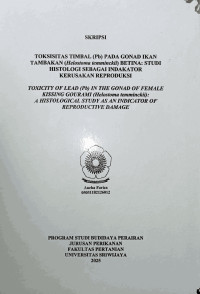
TOKSISITAS TIMBAL (Pb) PADA GONAD IKAN TAMBAKAN (Helostoma temminckii) BETINA: STUDI HISTOLOGI SEBAGAI INDAKATOR KERUSAKAN REPRODUKSI
Penilaian
0,0
dari 5Lead (Pb) is a toxic heavy metal that can cause damage to various organs, including the ovaries of female fish, which play a vital role in the survival and sustainability of fish populations. Considering that kissing gourami fish are often found in natural waters that may be exposed to lead contamination from human activities, such as rivers and swamps, it is important to understand the impact of lead exposure on the reproductive organs of fish for the sustainability of kissing gourami populations in aquatic ecosystems. This study employed four treatments in the toxicity test using Pb(NO₃)₂ concentrations of 20 mg L⁻¹, 30 mg L⁻¹, 40 mg L⁻¹, and 50 mg L⁻¹, followed by a 30-day maintenance period to histological examination. Mortality was observed in the lead toxicity test at the highest concentration, namely 50 mg L⁻¹, which resulted in approximately 66.6% fish mortality, and the result of the LC50-96 hours is 42,3%, accompanied by behavioral observations showing abnormal behavioral changes in the test fish during exposure. Histological analysis also revealed gonad damage in all test female fish, which reduced reproductive optimality or even led to failure. Although the doses used were not lethal, sublethal effects were observed that could impair reproduction and threaten population continuity and productivity. Gonad damage in female fish due to lead exposure included vacuolization, cytoplasmic fragmentation, follicular disruption, oocyte degeneration, irregular oocyte size, atresia, and edema. Key words: kissing gourami, lead, ovarium.
Availability
| Inventory Code | Barcode | Call Number | Location | Status |
|---|---|---|---|---|
| 2507006691 | T186875 | T1868752025 | Central Library (Reference) | Available but not for loan - Not for Loan |
Detail Information
- Series Title
-
-
- Call Number
-
T1868752025
- Publisher
- Indralaya : Prodi Budidaya Perairan,Jurusan Perikanan, Fakultas Pertanian Universitas Sriwijaya., 2025
- Collation
-
xiv, 58 hlm.; ilus.; tab.; 29 cm.
- Language
-
Indonesia
- ISBN/ISSN
-
-
- Classification
-
639.307
- Content Type
-
Text
- Media Type
-
unmediated
- Carrier Type
-
other (computer)
- Edition
-
-
- Subject(s)
- Specific Detail Info
-
-
- Statement of Responsibility
-
MI
Other version/related
File Attachment
Comments
You must be logged in to post a comment
 Computer Science, Information & General Works
  Philosophy & Psychology
  Religion
  Social Sciences
  Language
  Pure Science
  Applied Sciences
  Art & Recreation
  Literature
  History & Geography