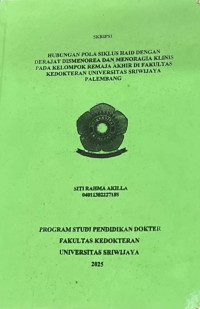
Skripsi
HUBUNGAN POLA SIKLUS HAID DENGAN DERAJAT DISMENOREA DAN MENORAGIA KLINIS PADA KELOMPOK REMAJA AKHIR DI FAKULTAS KEDOKTERAN UNIVERSITAS SRIWIJAYA PALEMBANG
Penilaian
0,0
dari 5Background. Female medical students represent a population at risk of experiencing menstrual disorders, particularly dysmenorrhea and clinical menorrhagia, due to several contributing factors such as early menarche and extreme body mass index. These factors can disrupt hormonal balance, leading to irregular menstrual cycle patterns. Irregular cycles, especially polymenorrhea, may elevate prostaglandin levels, which play a key role in triggering dysmenorrhea and clinical menorrhagia. Although this phenomenon is commonly observed among medical students, no recent official data have examined similar cases within the Faculty of Medicine at Sriwijaya University. Therefore, this study was conducted to investigate the relationship between menstrual cycle patterns and the severity of dysmenorrhea and clinical menorrhagia among female medical students at Sriwijaya University, Palembang. Methods. This study employed a cross-sectional design with a consecutive sampling technique. The sample consisted of active students from the 2022–2024 cohorts in the Medical Education Program at the Faculty of Medicine, Sriwijaya University, who met the inclusion and exclusion criteria. Data were collected online using Google Forms containing three instruments: a menstrual cycle questionnaire from the International Federation of Gynecology and Obstetrics (FIGO), the Aberdeen Menorrhagia Severity Scale (AMSS), and the Numeric Rating Scale (NRS). Results. The majority of respondents had a normal menstrual cycle pattern, with 93 individuals (75%) reporting it, 55 individuals (44,4%) experiencing moderate dysmenorrhea, and 115 individuals (92,7%) experiencing mild clinical menorrhagia. Fisher’s exact test showed no significant relationship between menstrual cycle patterns and the degree of dysmenorrhea (p=0,503) or clinical menorrhagia (p=1,000). Conclusion. There is no significant relationship between menstrual cycle patterns and the severity of dysmenorrhea and clinical menorrhagia in late adolescent female medical students.
Availability
| Inventory Code | Barcode | Call Number | Location | Status |
|---|---|---|---|---|
| 2507006689 | T186757 | T1867572025 | Central Library (Reference) | Available but not for loan - Not for Loan |
Detail Information
- Series Title
-
-
- Call Number
-
T1867572025
- Publisher
- Palembang : Prodi Pendidikan Kedokteran, Fakultas Kedokteran Universitas Sriwijaya., 2025
- Collation
-
xvii, 91 hlm.; ilus.; tab.; 29 cm.
- Language
-
Indonesia
- ISBN/ISSN
-
-
- Classification
-
618.172 07
- Content Type
-
Text
- Media Type
-
unmediated
- Carrier Type
-
other (computer)
- Edition
-
-
- Subject(s)
- Specific Detail Info
-
-
- Statement of Responsibility
-
MI
Other version/related
File Attachment
Comments
You must be logged in to post a comment
 Computer Science, Information & General Works
  Philosophy & Psychology
  Religion
  Social Sciences
  Language
  Pure Science
  Applied Sciences
  Art & Recreation
  Literature
  History & Geography