Skripsi
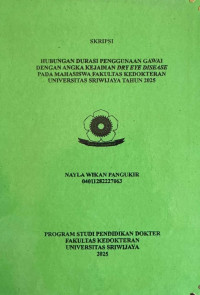
HUBUNGAN DURASI PENGGUNAAN GAWAI DENGAN ANGKA KEJADIAN DRY EYE DISEASE PADA MAHASISWA FAKULTAS KEDOKTERAN UNIVERSITAS SRIWIJAYA TAHUN 2025
Penilaian
0,0
dari 5Background: Dry eye disease (DED) is a multifactorial disorder of the ocular surface characterized by the loss of tear film homeostasis. The prevalence of DED in Indonesia reaches 27.5%, with the evaporative type being the most common. Prolonged use of digital devices significantly contributes to the development of DED. Radiation emitted from digital screens is more easily absorbed by younger tissues, making adolescents more susceptible to DED. This study aimed to analyze the relationship between the duration of digital device use and the incidence of DED among medical students at Sriwijaya University. Methods: This study employed an observational analytic design with a cross-sectional approach in July to October 2025. The study population consisted of medical students at Sriwijaya University in 2025. A total of 195 participants were recruited through consecutive sampling and interviewed using the Ocular Surface Disease Index (OSDI) questionnaire displayed on a digital screen. Simultaneously, blink frequency was observed over a one-minute period. Data were analyzed using univariate, bivariate (Chi-square and Fisher’s exact tests), and multivariate (logistic regression) analyses with SPSS version 27. Results: Among 195 participants, 111 students used digital devices for >8 hours/day (63,8%), and 6 students used them for ≤8 hours (28,6%) were identified as having DED. Bivariate analysis showed a significant association between the duration of digital devices use and the incidence of DED (p=0,002). Multivariate analysis demonstrated that the duration of digital device use (p=0,003) was an independent factor associated with DED. Conclusion: The findings indicate that the duration of digital device use is an independent factor that has a clinically and statistically significant effect on the increased incidence of DED among medical students. Blinking frequency, age, and gender were not statistically significant factors associated with DED.
Availability
| Inventory Code | Barcode | Call Number | Location | Status |
|---|---|---|---|---|
| 2507006653 | T186552 | T1865522025 | Central Library (Reference) | Available but not for loan - Not for Loan |
Detail Information
- Series Title
-
-
- Call Number
-
T1865522025
- Publisher
- Palembang : Prodi Pendidikan Kedokteran, Fakultas Kedokteran Universitas Sriwijaya., 2025
- Collation
-
xx, 118 hlm.; ilus.; tab.; 29 cm.
- Language
-
Indonesia
- ISBN/ISSN
-
-
- Classification
-
617.707
- Content Type
-
Text
- Media Type
-
unmediated
- Carrier Type
-
other (computer)
- Edition
-
-
- Subject(s)
- Specific Detail Info
-
-
- Statement of Responsibility
-
MI
Other version/related
File Attachment
Comments
You must be logged in to post a comment
 Computer Science, Information & General Works
  Philosophy & Psychology
  Religion
  Social Sciences
  Language
  Pure Science
  Applied Sciences
  Art & Recreation
  Literature
  History & Geography