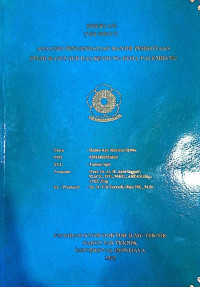
Skripsi
ANALISIS PENGENDALIAN BANJIR PERKOTAAN STUDI KASUS SUB DAS BENDUNG KOTA PALEMBANG
Penilaian
0,0
dari 5
Introduction: The Bendung Sub-watershed in Palembang City is a lowland area highly prone to flooding due to decreased channel capacity, sedimentation, channel constriction, sharp meanders, and suboptimal pump performance. These conditions lead to recurrent inundation during extreme rainfall events, with excessively long drainage times. Such issues necessitate a comprehensive hydrological–hydraulic assessment to understand flow characteristics and formulate technical interventions capable of effectively enhancing flood-control capacity. Methods: The hydrological analysis employed the Thiessen Method for spatial rainfall distribution and the Gumbel Method to determine design rainfall. Design flood discharge was calculated as input for hydrodynamic modeling using DUFLOW to simulate existing conditions and various engineering scenarios. The tested scenarios included dredging, river widening, channel straightening, embankment elevation of retention ponds, and pump optimization using jetflow technology. Modeling was conducted across several river segments to evaluate changes in water levels and inundation duration. Results: Simulations of existing conditions show water levels overtopping the ground surface by 50–130 cm, with drainage times exceeding one day. After the implementation of engineering scenarios, water levels in most segments decreased by 20–60 cm compared to initial conditions and returned below ground elevation. Inundation duration also decreased significantly to only 40–60 minutes. Segments previously considered critical—particularly B3, B7, B10, and B11—exhibited the most substantial improvement in flow capacity following combined dredging, widening, and pump optimization measures. Discussion: Findings indicate that hydraulic capacity improvement cannot be achieved through a single intervention but requires an integrated approach. River normalization increases flow cross-section, while jetflow technology proves effective in accelerating flow response in flat rivers and reducing backflow from pumps. Enhancing retention pond capacity and embankment height contributes to stabilizing water levels during peak discharge. Overall, the combined engineering strategies are the most effective approach for improving the flood-control performance of the Bendung Sub-watershed and can serve as a basis for sustainable infrastructure planning in urban lowland areas. Keywords: Sub-watershed, Urban flood control, Hydrologic–hydraulic modeling, DUFLOW, River normalization, Jetflow technology
Availability
| Inventory Code | Barcode | Call Number | Location | Status |
|---|---|---|---|---|
| 2507006638 | T186470 | T1864702025 | Central Library (Reference) | Available but not for loan - Not for Loan |
Detail Information
- Series Title
-
-
- Call Number
-
T1864702025
- Publisher
- Palembang : Prodi Doktor Ilmu Teknik, Fakultas Teknik Universitas Sriwijaya., 2025
- Collation
-
xxiii, 336 hlm.; ilus.; tab.; 29 cm.
- Language
-
Indonesia
- ISBN/ISSN
-
-
- Classification
-
627.407
- Content Type
-
Text
- Media Type
-
unmediated
- Carrier Type
-
other (computer)
- Edition
-
-
- Subject(s)
- Specific Detail Info
-
-
- Statement of Responsibility
-
MI
Other version/related
File Attachment
Comments
You must be logged in to post a comment
 Computer Science, Information & General Works
  Philosophy & Psychology
  Religion
  Social Sciences
  Language
  Pure Science
  Applied Sciences
  Art & Recreation
  Literature
  History & Geography